
All Municipal Candidates Education Session: Understanding the Issues, the Systems, and the Municipal Role
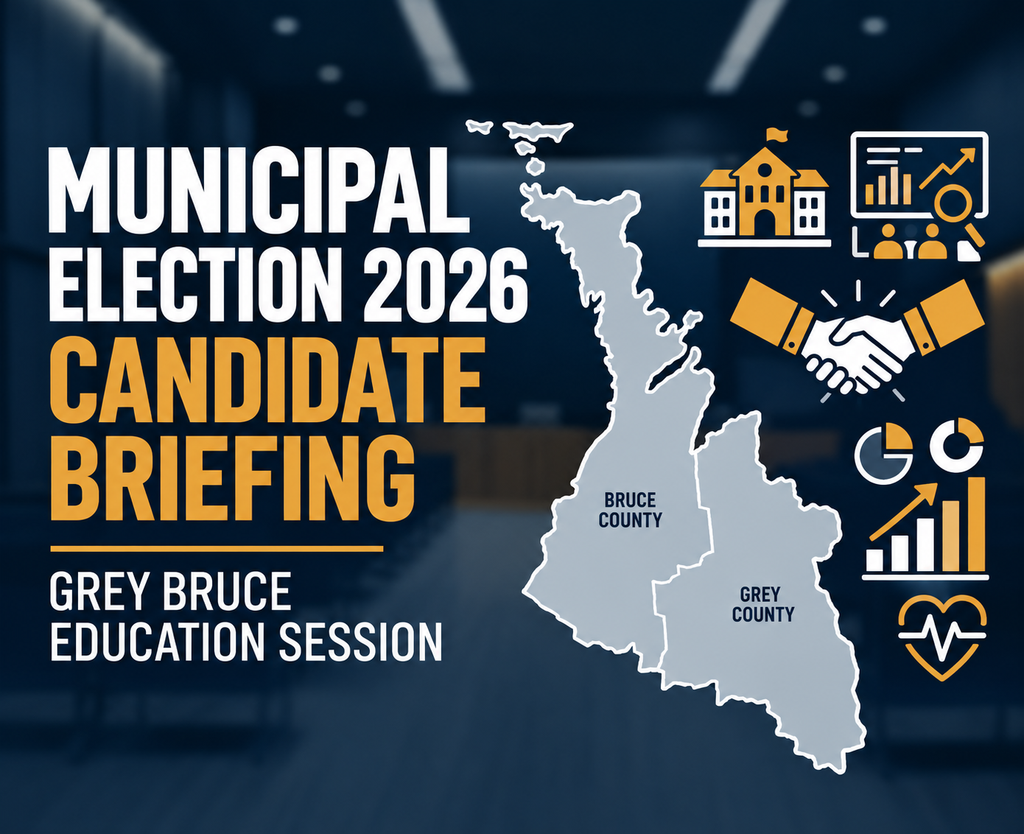
On September 18, 65 people joined us online for our All Municipal Candidates Education Session.
Watch the All Municipal Candidates Education Session on YouTube:
United Way of Bruce Grey hosted the session through the Bruce Grey Poverty Task Force as a non-partisan opportunity for municipal candidates to learn more about poverty, housing, health, transportation, and community safety in Grey Bruce.
But the purpose wasn’t to tell candidates what to think.
In fact, we hoped something almost opposite would happen.
We hoped they would leave with some answers and possibly better questions.
Poverty is complicated because the systems are complicated
Municipal councils make decisions that affect people’s lives every day.
They make decisions about land use, zoning, infrastructure, transportation, public spaces, facilities, economic development and community partnerships.
But many of the biggest policy levers affecting poverty don’t sit at a municipal council table.
Ontario Works and ODSP rates aren’t set by local councillors. Neither is minimum wage. Health and mental-health systems are largely provincial responsibilities. Many income benefits are provincial or federal. Counties have responsibilities for housing, homelessness, and social services that lower-tier municipalities do not.
And then there are organizations like United Way and dozens of other community partners trying to help people navigate what happens where all those systems meet.
That’s why one of the simplest questions we wanted candidates to leave asking was:
Who actually has the influence?
Sometimes the answer is the municipality.
Sometimes it’s the County.
Sometimes it’s Queen’s Park or Ottawa.
Sometimes there is no need to invent a new program because one already exists. The actual problem may be that it doesn’t have enough capacity to meet the need.
That distinction matters.
The questions got more focused
The three presenters approached the issues from very different perspectives.
Jason Weppler of Grey Bruce Public Health talked about the social determinants of health and the conditions that shape people’s health beyond the doctor’s office.
Former Grey County CAO Kim Wingrove tackled the deceptively complicated question of “Who does what?”
Retired West Grey Police Chief Rob Martin explored what happens when poverty, homelessness, mental health and substance use arrive at the door of the justice system, and why police cannot solve social and health problems through enforcement alone.
Throughout the session, candidates were invited to submit questions to the presenters through the Zoom chat while attendees remained muted. As the presentations unfolded, those questions began to build on one another. At times, participants added context, examples or brief comments related to the questions being discussed, creating a natural exchange alongside the formal presentations and responses.
The result was less a list of isolated questions and more a window into what candidates were trying to understand.
They asked about affordable housing and living wages. Tiny homes, modular housing, zoning and additional residential units. Housing First. Encampments. Food security. Addiction. Police services. Energy poverty. Rural transportation. Prevention. Community land trusts. Program outcomes.
And this may have been the most interesting part of the morning.
But increasingly, the questions weren’t simply “What should we do?”
They became:
What already exists?
What can a municipality actually do?
Where is the gap?
How would we know whether it worked?
That was exactly the conversation we hoped to create.
What does “success” mean?
At one point, a candidate asked whether there were statistics showing how many people successfully go through social programs and get back on their feet.
It’s a perfectly reasonable question.
But before answering it, we stopped at one word:
Success.
What does success mean?
A month without needing help? Six months? A year? A lifetime?
For somebody experiencing homelessness, success today might mean attending outreach and coming back tomorrow.
For someone else, it might mean maintaining housing.
For another person, it might mean reducing repeated encounters with hospitals, police or emergency shelters.
And sometimes a program can be demonstrably helping people while still appearing overwhelmed because the number of people needing it exceeds its capacity.
That’s the difference between a program that isn’t working and a program that cannot meet all of the demand being placed upon it.
Those lead to very different public-policy conversations.
Curiosity before conclusions
United Way’s direct community work gives us a particular window into these systems.
The Poverty Task Force gives us a place to bring those experiences together with the knowledge of partners working in public health, housing, social services, food security, legal services, municipalities and other sectors.
The pattern becomes evidence.
And sometimes that evidence tells us the system itself needs attention.
That is why we developed Curiosity Before Conclusions and why we shared it with every municipal candidate we could reach.
Complex community issues deserve hard questions.
We simply want those questions to begin with curiosity.
Now we’re sharing the conversation
Not every candidate could spend 90 minutes with us on a Friday morning. Many who could not attend asked for the meeting materials. We hope they ask questions.
Watch the All Municipal Candidates Education Session on YouTube: https://youtu.be/4yLuhvYdgp4
